
Dudran Village: The Last Milk Village of Kashmir An offbeat corner of Uri where refrigerators never really caught on
Somewhere between Baramulla town and the Uri sector, tucked into a fold of the hills that most tourist maps simply skip, there's a village of roughly 130 households that never bothered switching to electric fridges. Not because they couldn't. Because they didn't need to.
They have something older, and honestly, better suited to the job.
The village is called Dudran. Locals call it the "Milk Village," and once you understand why, you'll wonder why it isn't already on every serious Kashmir traveler's list.
Where Exactly Is Dudran?
Dudran sits in Boniyar tehsil of Baramulla district, roughly 14 km from Boniyar town and about 38 km from Baramulla, on the stretch between Baramulla and Uri. It's a small hamlet — a few hundred people, a handful of streets, and hills pressing in close on every side.
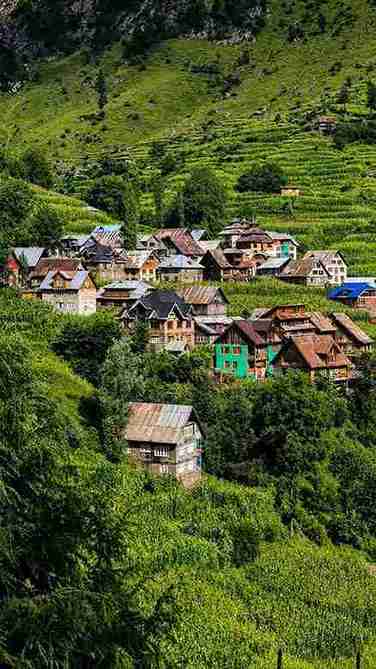
Don't expect a bazaar or a big signboard announcing you've arrived. Dudran reveals itself slowly, in details: a stone wall here, a spring-fed structure there, the smell of fresh curd drifting from somewhere close by.
| Quick Facts | Details |
|---|---|
| District | Baramulla |
| Tehsil | Boniyar |
| Distance from Baramulla | ~38 km (approx. 1 to 1.25 hrs by road) |
| Distance from Srinagar | ~90 km (approx. 2.5 to 3 hrs by road) |
| Known for | Traditional dairy preservation (Doud Khot) |
| Best suited for | Cultural travelers, photographers, offbeat explorers |
The Doud Khot: A Fridge Kashmir Invented Centuries Ago
Here's the part that actually stops people in their tracks.
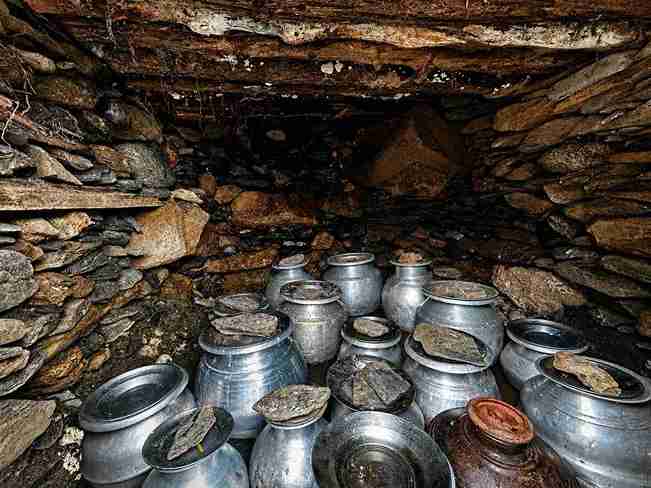
Every household in Dudran has what's locally called a Doud Khot — a small cave-like structure, walled in stone with a wooden roof, usually built right beside or over a natural spring. Milk, curd, and butter go inside. No electricity, no compressor, no monthly bill. Just cold spring water doing what it's done for generations.
The process of turning milk into butter and curd here is called Gurus, and in Kashmiri summers, buttermilk made this way is still considered something of a local delicacy. An elderly resident once put it simply: the villagers are using techniques their ancestors used, and intend to keep using them.
According to local Animal Husbandry estimates, the wider Uri belt produces close to 19,000 tonnes of milk a month — and Dudran alone contributes around 1,800 litres a day. For a village this size, that's not a small side business. It's the backbone of the local economy, and it's kept fresh entirely by stone, water, and patience.
A Village Built the Old Way
It isn't just the dairy caves. Walk through Dudran and you'll notice the houses themselves are made from stone, wood, and mud — the kind of vernacular architecture that's disappearing fast across rural Kashmir. Many families still use a traditional stone-and-wood flour mill called a Gratt instead of an electric grinder.
Winters here are brutal — snow can pile up to 15 feet in a hard year — so the village has also perfected the art of drying vegetables to survive months of isolation. Nothing here is done for show. It's simply how life has always worked in this pocket of Uri.
There's talk of Dudran being proposed for heritage status, which tells you two things: the tradition is genuinely rare, and it may not stay exactly like this forever. That's usually the moment worth visiting a place, not after it's been "discovered."
- Doud Khots — natural spring-cooled dairy storage caves, one per household
- Stone-and-mud houses built with centuries-old techniques
- Traditional Gratt (stone flour mills) still in daily use
- Sun-dried vegetables preserved for the harsh winter months
- A close-knit community of roughly 130 households, largely undisturbed by tourism
What It's Actually Like to Visit
There's no ticket counter in Dudran. No souvenir stand. What you get instead is quieter and, frankly, more valuable — a real look at how rural Kashmir has sustained itself for generations.
Go slow here. Sit with a local family if you're invited (and in a village like this, you probably will be — Kashmiri hospitality doesn't discriminate by how remote the village is). Ask about the Doud Khot. Watch how buttermilk is churned by hand. Photograph the stone houses in the low evening light, when the whole valley turns gold.
This isn't a place you "do" in twenty minutes. It rewards people who linger.
How to Reach Dudran
The easiest route is Srinagar → Baramulla → Boniyar → Dudran, mostly along the Srinagar–Uri highway before a short detour on a local link road. Realistically, that's a half-day round trip from Srinagar, or a natural stop if you're already heading toward Uri for the day.
A couple of practical things worth knowing:
- Public transport is limited to shared vans, so a private vehicle makes the visit far smoother
- Uri is close to the Line of Control, and travel formalities in the sector can change — it's worth confirming current access requirements before you plan the trip
- Mobile connectivity thins out as you get closer to the village, so download offline maps in advance
This is exactly the kind of route where having a local operator sort the logistics — permissions, route timing, and a driver who actually knows the village — saves you a wasted trip. If you'd rather not gamble a half-day on uncertain road and access conditions, our offbeat Kashmir experiences can build Dudran into a day trip alongside Uri and Baramulla.
Best Time to Visit
Late spring through early autumn — roughly April to October — is when Dudran is at its most alive. That's when dairy production peaks, the village is snow-free and accessible, and the surrounding hills are green.
Winter isn't advisable for a casual visit. With snow reaching up to 15 feet in parts, the village turns fairly cut off, and road access becomes unreliable.
Pair Dudran With
Since you're already out that way, it makes sense to build a full day around it rather than a single stop.
- Uri — for the Line of Control viewpoints and the Jhelum's dramatic gorge
- Baramulla — the historic gateway town, en route both ways
- Other offbeat villages in North Kashmir — if slow, authentic travel is what you're after, Dudran is just the beginning
Frequently Asked Questions
Is Dudran village open to tourists?
Yes, Dudran is a functioning village, not a restricted zone, and visitors are welcome. That said, it's not set up for tourism in any formal sense — no entry desk, no guides on standby — so a bit of courtesy and a local contact go a long way.
What is a Doud Khot?
A Doud Khot is a small, cave-like stone-and-wood structure built near a natural spring, used by Dudran's families to store milk, curd, and butter at a naturally cool temperature — essentially a fridge that runs on nothing but spring water.
How far is Dudran from Srinagar?
Around 90 km, roughly a 2.5 to 3 hour drive via Baramulla and Boniyar, depending on road and weather conditions.
Can I visit Dudran on a day trip from Srinagar?
Yes, it works well as a day trip, especially if combined with Uri and Baramulla so the drive isn't spent solely on Dudran.
Is Dudran safe to visit, given its proximity to Uri?
Dudran itself is a regular civilian village, but the Uri sector does sit close to the Line of Control, and access rules in border areas can shift. It's worth checking current conditions or traveling with a local operator familiar with the route.
Kashmir's popular circuit — Gulmarg, Pahalgam, Sonmarg — is beautiful, no argument there. But villages like Dudran are where you actually meet Kashmir, not just photograph it. If an offbeat detour like this sounds like your kind of travel, get in touch with Thrill Top Journeys and we'll build it into your itinerary — permissions, routing, and local access sorted, so all you have to do is show up.