
From Razdan Pass to Keran: Riding to the Last Villages of Kashmir A bike journey through Gurez, Chakwali, Angaikot — and the river that runs between two countries
Some trips take weeks to plan. Some take years to forget. This one did both.
My best friend and I rented bikes from Thrill Top Journeys in Srinagar and pointed ourselves toward Gurez Valley, one of those places that barely shows up on tourist maps and shows up everywhere in the memories of people who've been. We had an itinerary. We had a route. What we didn't have was any idea that the man who built that itinerary would end up riding alongside us, feeding us shawarma at 11,000 feet, and arranging lunch inside a schoolboy's home in a village most people have never heard of.
Kashmir doesn't do ordinary. This trip was proof.
Razdan Pass & Shawarma at 11,000 Feet
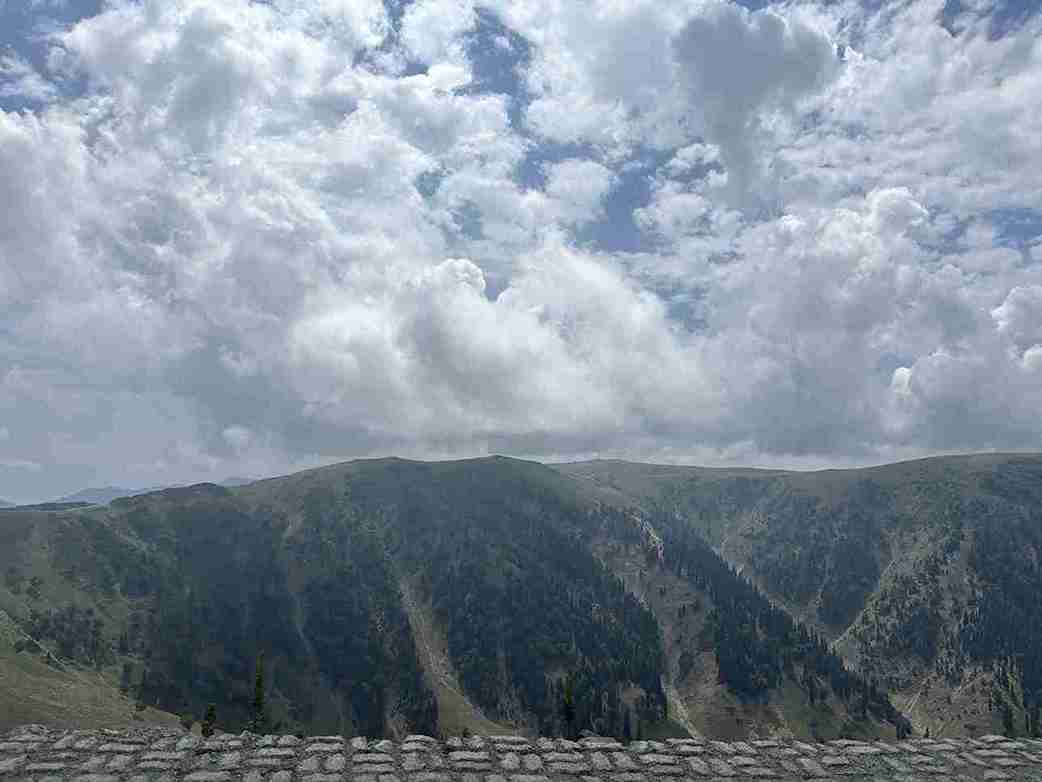
The road from Srinagar climbs hard and fast. By the time you reach Razdan Pass — one of the most iconic mountain crossings in South Asia, sitting at roughly 11,000 feet above sea level where your lungs are working overtime and the views are doing something strange to your sense of scale. The valleys below look like paintings. The sky feels closer than it should.
That's where we met him.
Basit Ahmad Bhat, founder of Thrill Top Journeys, was standing on the pass with a group of friends, completely unbothered by altitude, running a full barbecue setup like it was the most natural thing in the world. We had been communicating over the phone for weeks & he'd designed our entire route, but this was the first time we'd actually seen each other in person. On a mountain. At 11,000 feet. Next to a grill.
"Do you eat non-veg?" he asked.
We said yes. He handed us chicken shawarma. On a mountain pass. At altitude. It was, without exaggeration, the best shawarma either of us had eaten in our lives and I say that fully aware of how ridiculous that sentence sounds. His friends were warm, generous with food, and economical with words. The kind of hospitality that doesn't announce itself.
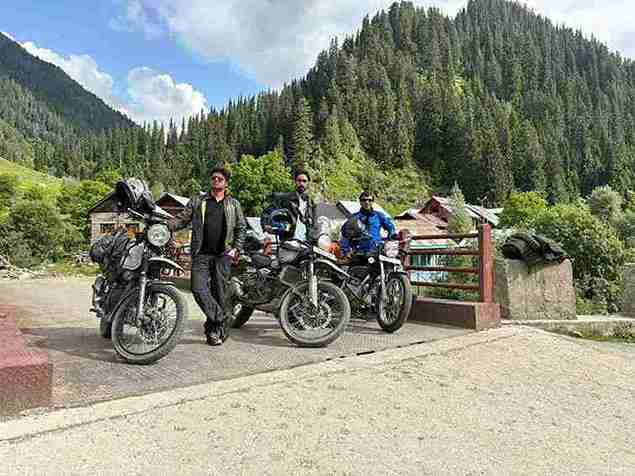
Then Basit said he'd ride with us to Gurez. Called his friend Imran to join. And just like that, our two-person trip became four.
I won't pretend I wasn't slightly nervous about it. Road trip energy is a fragile thing. Add the wrong person and the whole vibe can go sideways. But within the first few kilometres past the pass, the worry evaporated. Imran was easy. Basit was... well, he was exactly what you'd expect from someone who spends his life building routes through difficult, beautiful places. Calm. Sure-footed. Completely at home.
Into Gurez — The Valley That Fixes You
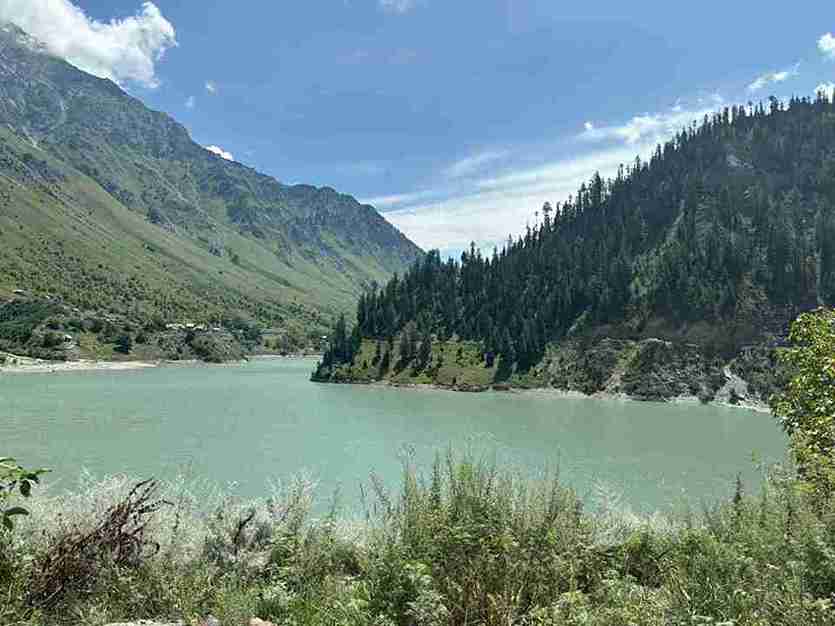
The descent from Razdan Pass into Gurez Valley is one of those stretches of road that ruins you for normal drives. Hairpin bends, pine ridgelines, the distant silver thread of the Kishanganga River, and a silence so complete you can hear your own thoughts getting quieter. It's the kind of landscape that doesn't perform for you. It just is.
We rolled into Gurez in the afternoon. I had pre-booked a room on Agoda feeling quite organised about the whole thing, honestly. The hotel informed us, with zero drama, that they weren't accepting Agoda bookings.
Travel does this. Reminds you that all your plans are suggestions.
Basit sorted it. No fuss, no performance and he made a call, found us a comfortable room, done. It was the first of several moments on this trip where having someone who actually knows the valley was worth more than any booking platform.
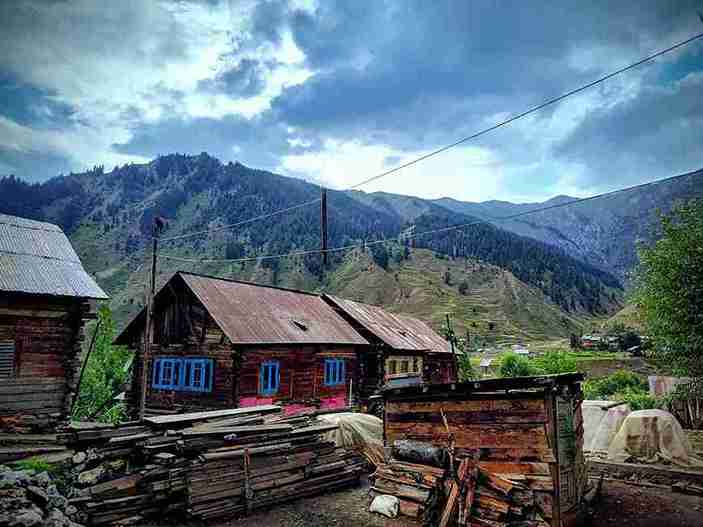
We explored Gurez the next morning. The valley is home to the Dard community, Shina-speaking people with a distinct culture and architecture, wooden homes stacked against hillsides, faces that carry the particular dignity of people who've lived between mountains and borders for centuries. The Habba Khatoon Peak watches over everything, named for Kashmir's beloved 16th-century poetess. The meadows are absurdly green. The river is cold and fast and constant.
Some places ask you to do things. Gurez asks you to sit down and pay attention.
The Road to Chakwali — A Schoolboy, a Lift, and the Lunch We Didn't Expect
Past Gurez, the road stops being polite. Toward Chakwali, it becomes a negotiation, tarmac giving way to gravel giving way to mud giving way to sheer optimism. This is the part of Kashmir that most travellers never reach. Which is exactly why you should go.
Somewhere on that road, we passed a school kid walking alone. Basit pulled over without hesitation and offered him a lift.
His name we never quite caught — but his story stayed with us. He was a student who lived 17 kilometres from his school. Every single day. If he was lucky, someone stopped. If he wasn't, he walked. Both ways. This wasn't a hardship he complained about. It was just Tuesday. The matter-of-fact way he said it and that hit harder than any dramatic retelling could.
Basit and the boy got talking, the way people do when there's nothing between them but road and honesty. And somewhere in that conversation, an invitation was extended. The boy's family wanted to host us for lunch.
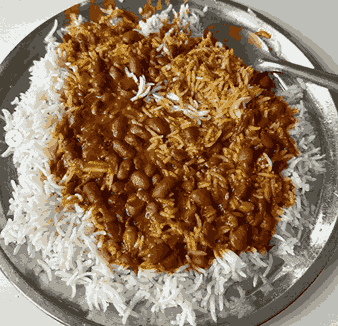
We sat in a home in Chakwali — a real home, not a guesthouse, not a restaurant and ate Gurezi Rajma Dal with rice. If you haven't had rajma cooked this way, in a Gurez kitchen, by people who grow the beans themselves, I'm not sure I can describe it adequately. It was warm and deep and tasted like the valley itself. The kind of meal that doesn't just feed you. It folds you in.
We stayed longer than planned. Nobody rushed us.
Angaikot — Where the Map Gets Vague
From Chakwali we pushed on to Angaikot. It barely registers on most maps. It registered permanently on us.
The views here opened up in a way that felt almost aggressive, sweeping ridgelines, the border geography making itself known in the shape of the peaks, the sense that you were standing at the edge of something. Not the edge in a scary way. The edge in a way that makes you feel precisely the right size: small, present, awake.
There were no tourists. No chai stalls aimed at outsiders. Just the village, the wind, and the mountains doing what mountains do — refusing to be rushed.
We didn't stay long. But we didn't leave quickly either.
Lunch in Sopore — Mann Te Salva and a Farewell
The ride back was its own kind of beautiful and familiar road, different eyes. By the time we reached Sopore, we were hungry in the honest, uncomplicated way that follows a full day of mountain riding.
We stopped at Mann Te Salva. If you're passing through Sopore and you skip this place, I genuinely don't know what to tell you. The food is the kind that earns its reputation quietly, through repetition and consistency rather than hype. We ate well. We ate a lot. We sat there longer than strictly necessary.
It was also where we said goodbye to Basit.
He'd ridden with us through the pass, sorted our room, stopped for a school kid on a remote road, arranged a home-cooked lunch in Chakwali, guided us through tracks that Google Maps would simply refuse to acknowledge and now he was heading home. Road friendships don't need much ceremony. We said what needed saying over tea, and he rode off.
And then there were two again.
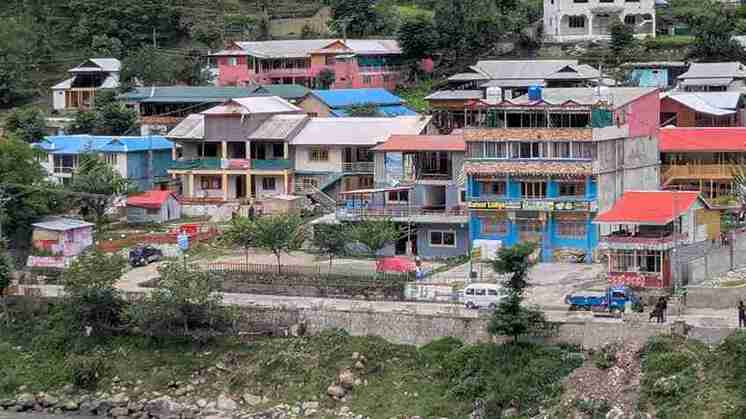
Keran — The River that bisects Kashmir
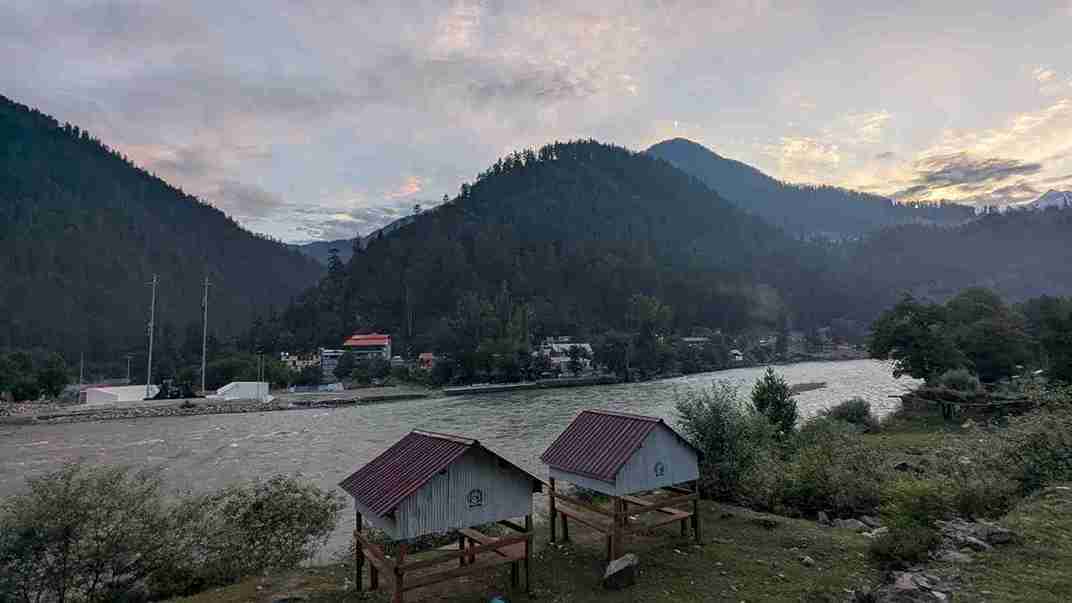
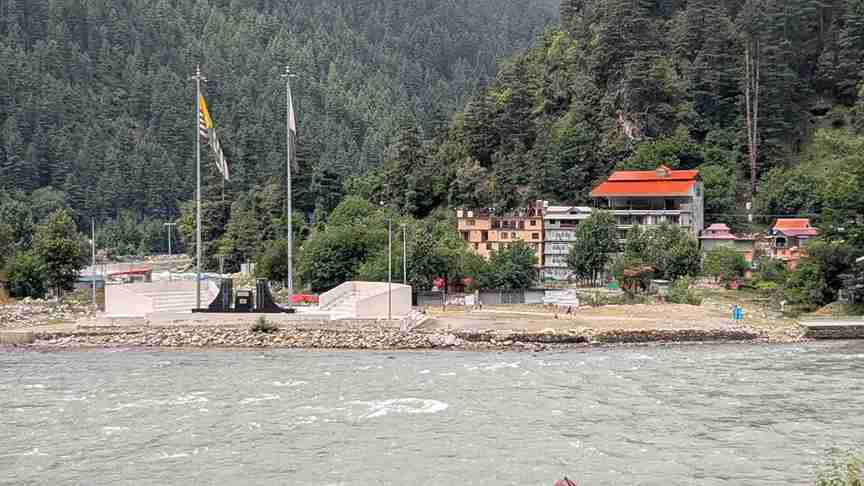
Keran sits on the banks of the Kishanganga River, directly across from Pakistan- occupied Kashmir. It is, in the most literal sense, one of the last villages before India ends, at least in this part of the map.
Across the river, you can see homes. Hear sounds. Sometimes make out figures going about their day. Ordinary life continuing on the other side of an extraordinary divide. The Line of Control here is not a wall or a fence. It's a river. And rivers, as rivers tend to do, move without asking anyone's permission.
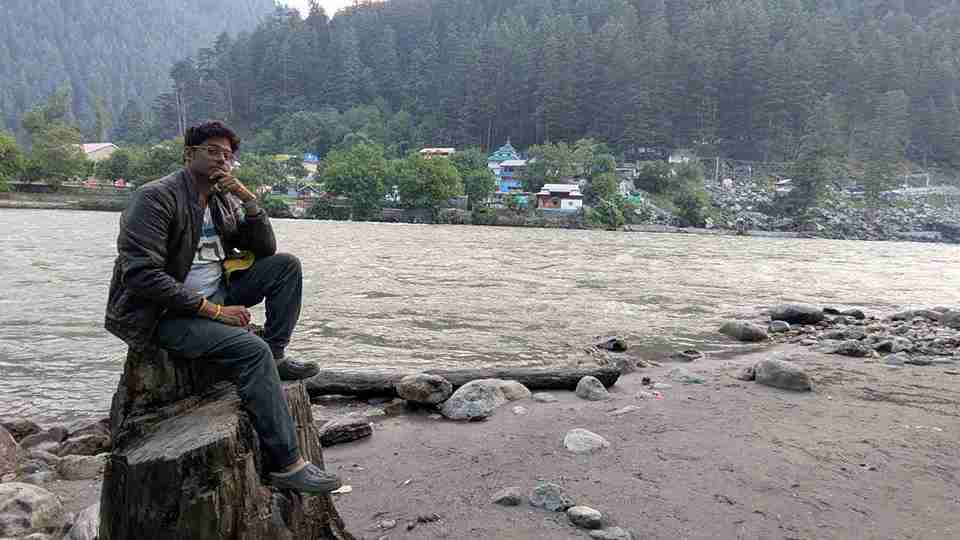
The village is quiet in the way that places carrying heavy histories sometimes are not sad, not tense, just aware. We sat by the Kishanganga as the light changed and didn't say much. Some experiences don't need commentary.
Keran stays with you. I'm not entirely sure why. Maybe it's the geography. Maybe it's the sound of the water. Maybe it's what it makes you think about borders and rivers and ordinary people living their lives on either side of lines drawn by people who never lived there.
The Apricots — A Goodbye We Didn't See Coming
On the return from Keran, a package was waiting for us. Sent by Basit.
A box full of fresh apricots the kind that don't travel well and don't need to, because they're meant to be eaten where they're grown. But attached to the box was a QR code. We scanned it.
It led to a video of Basit picking those apricots himself. Fresh from the tree, for us, filmed so we could see exactly where they came from and whose hands had touched them.
I don't know if that counts as hospitality or poetry. Maybe it's both. Maybe in Kashmir, there isn't always a difference.
We ate them in the car. They tasted like the whole trip, tart and sweet and completely unrepeatable.
Travel Tips — If You're Planning This Route
| Detail | What You Need to Know |
|---|---|
| Permits | Protected Area Permit (PAP) required for non-J&K residents. Apply via District Magistrate, Bandipora — or let your tour operator handle it. |
| Best Time | June to September. Razdan Pass closes November–May due to heavy snowfall. |
| Getting There | Srinagar → Bandipora → Razdan Pass → Gurez. Roughly 125–130 km, 4–5 hours in good conditions. |
| Bike Rental | Thrill Top Journeys (thrillop.com) — well-maintained bikes, curated itineraries, local expertise. Worth every rupee. |
| Accommodation | Book through a local operator. Online platforms like Agoda list properties that may not honour bookings on arrival. |
| Connectivity | Very limited beyond Gurez town. Download offline maps before leaving Srinagar. Tell people your plan. |
| Food | Carry snacks and water for the road. Don't miss Gurezi Rajma Dal if offered. Mann Te Salva in Sopore on the way back. |
Quick Essentials
- Carry permit copies — multiple sets, physical and digital
- Adventure/trail bike strongly recommended over standard commuters
- Pack layers — temperature drops fast above Razdan Pass
- Cash only beyond Bandipora — no ATMs in Gurez
- Scan the QR if Basit sends you apricots. Trust me on this one.
Frequently Asked Questions
Is Gurez Valley safe to visit?
Yes. Gurez is open to Indian tourists with the required permit. The area has a significant military presence precisely because of its border location, but travellers are welcomed warmly. Exercise standard sensible precautions and always follow local guidance at checkpoints.
Can I ride to Chakwali and Keran on a normal bike?
Technically possible, but not comfortable. The road beyond Gurez toward Chakwali is rough — gravel, mud, broken patches. A trail or adventure bike handles it far better. If you're renting through Thrill Top Journeys, discuss this with them beforehand; they know exactly what the road demands.
How do I contact Thrill Top Journeys to plan a similar trip?
Visit thrillop.com to find Basit and his team. They handle everything — bikes, permits, itineraries, accommodation — and, based on personal experience, will probably feed you somewhere extraordinary along the way.
What is the Gurezi Rajma Dal and where can I eat it?
Gurezi Rajma (red kidney beans) is a local variety grown in the Gurez Valley, smaller and more flavourful than the common variety found elsewhere. Cooked slow with minimal spice, it's rich and deeply satisfying. You're most likely to encounter it in local homes rather than formal restaurants — which is, of course, exactly the point.
Is Keran village accessible to tourists?
Keran is accessible to Indian tourists with the appropriate permits. It sits very close to the Line of Control so military checkpoints are part of the journey. Always carry your ID and permit documentation. Do not photograph military installations. Respect local directions at all times.
What This Trip Actually Is
People talk about Kashmir in the language of conflict, or in the language of Dal Lake and shikaras and houseboats. Both are real. But there's a third Kashmir — the one that exists past Razdan Pass, down roads that don't get smoothed over for tourists, in villages where a schoolboy hitch-hikes 17 kilometres each way to sit in a classroom.
This trip is that Kashmir.
It's not always comfortable. The roads are real roads, not scenic drives. The distances are real distances. The permit process requires patience. But what you find at the end of it the people, the food eaten in actual homes, a box of hand-picked apricots with a QR code attached, a river flowing between two countries with total indifference to their politics and none of that is available on any package tour.
Go. Ride slow. Accept the shawarma at the pass. Say yes to lunch in Chakwali.
Kashmir has a way of giving back exactly as much as you're willing to receive.
About the Author
- Vinayak Nayak
- Engineer by profession. Traveller by calling.
- The mountains don't care about your job title and that's exactly why Vinayak keeps going back to them. When he's not solving problems at work, he's out creating new ones on remote roads with no signal and too much luggage.
- Connect on LinkedIn
- Route: Srinagar → Razdan Pass → Gurez → Chakwali → Angaikot → Sopore → Kupwara → Keran → Srinagar
- Duration: Minimum 5–6 days recommended
- Organised by: Thrill Top Journeys — Basit Ahmad Bhat